Google Ranking Growth
Ready to Grow Your Google Rankings?
If your rankings have stalled or dropped, we’ll identify exactly what’s holding your site back — before you commit.
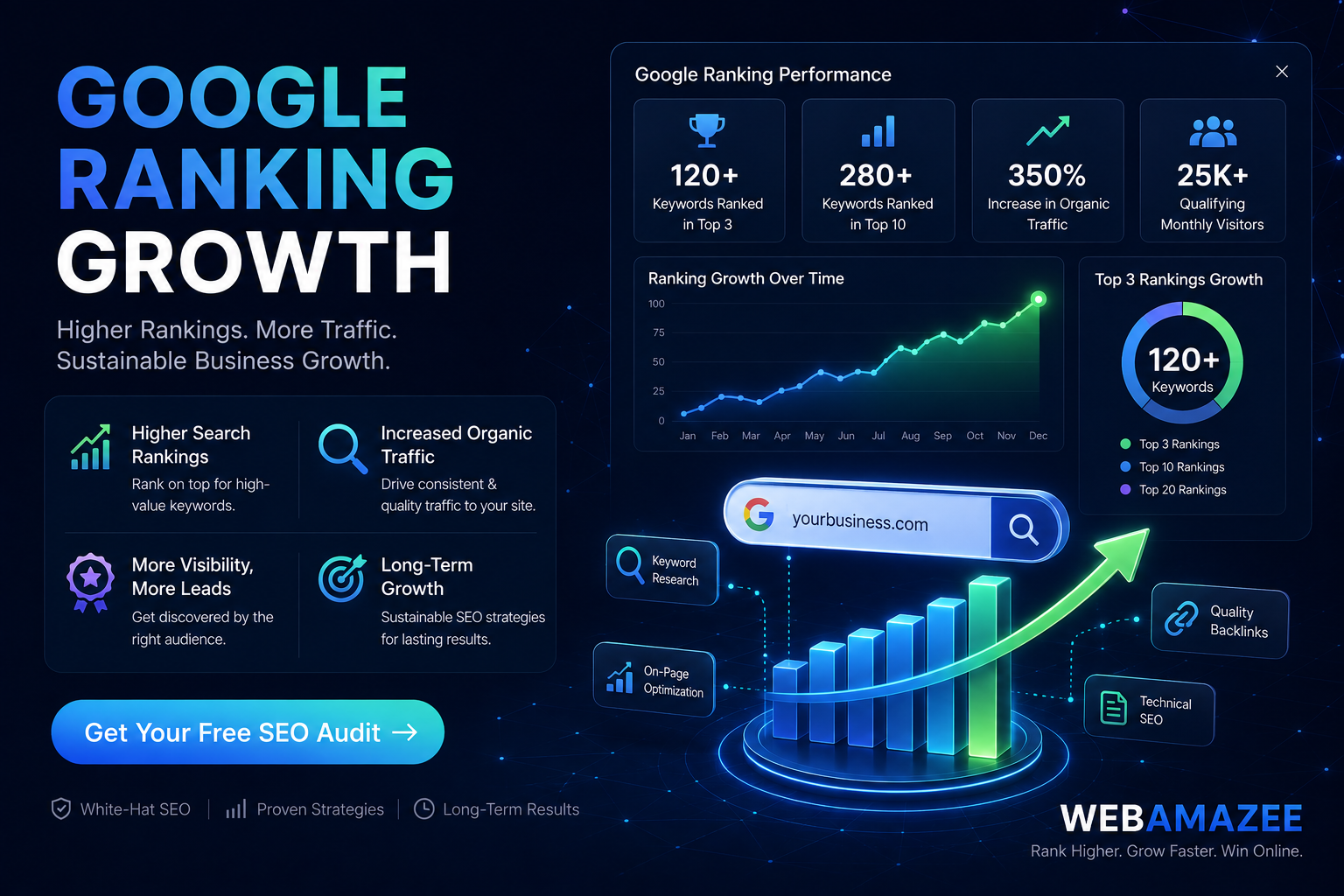
Sustainable ranking gains built on evidence, not guesswork
Rankings move because Google is constantly re evaluating whether your pages deserve their position, not because of a single trick someone found last month. Webamazee builds ranking growth around that reality, using a repeatable process we call the Webamazee Google Ranking Growth Framework™, so improvements hold up instead of disappearing after the next core update.
If you have watched a competitor climb past you with content that seems thinner than yours, or if your rankings have plateaued despite months of effort, this page explains what is actually happening and how we fix it.
What Are Google Ranking Growth Services
Google Ranking Growth Services are structured programs that improve a website’s organic search position by strengthening the factors Google actually uses to evaluate quality, relevance, and trust, including content depth, technical performance, search intent alignment, and credible external signals. Rather than chasing a single tactic, the work addresses the full set of conditions Google checks before deciding a page deserves to rank above another.
Rankings improve when a page becomes measurably more useful, more relevant, and more trustworthy relative to the pages currently outranking it. That sounds obvious once stated plainly, but most businesses never see it framed this way, because most SEO conversations focus on isolated tactics like backlinks or keyword density instead of the underlying comparison Google is actually making between your page and everyone else competing for the same query.
Rankings also fluctuate constantly, and that fluctuation is normal rather than alarming. Google runs algorithm updates, both broad and narrow, throughout the year, and each update reshuffles how existing signals get weighted. A page that ranked well under one weighting can slip under another, even with no changes made to the page itself. Understanding this is part of why we track ranking volatility separately from ranking decline, since the two require completely different responses.
Google evaluates websites using a combination of automated crawling, machine learning models trained to assess quality and relevance, and documented quality guidelines published through Google Search Central. Those guidelines describe what Google’s systems are trying to reward, even though the exact internal calculations remain proprietary. Our job is translating that public guidance into decisions on your actual pages, prioritized by what will move the needle fastest for your specific situation.
Why Google Ranking Growth Matters
Ranking position is not a vanity metric. It is the mechanism that determines whether the other parts of your marketing budget get a fair chance to work.
Organic traffic compounds in a way paid traffic does not. A page that ranks well keeps generating visits every month without a recurring media spend attached to each click. We have watched clients redirect budget away from paid channels entirely once a handful of key pages started ranking consistently, simply because the organic channel became the better return.
Brand visibility shapes trust before a visitor ever reads a word of your copy. Appearing repeatedly at the top of relevant searches signals credibility the same way seeing a company mentioned by people you trust does. A business ranked on page one for its core terms is treated differently by a searcher than one they have to dig for.
Lead generation and revenue growth are the direct outcome of the first two points, but only if search intent is matched correctly. Ranking for a term that does not align with what your business actually sells produces traffic that never converts. We have audited pages ranking well for informational queries that were driving zero revenue, simply because the page was built to sell rather than to inform, and Google or the searcher noticed the mismatch immediately.
Technical SEO and user experience determine whether any of the above is even possible. A page can have excellent content and still lose to a slower, less content rich competitor if crawlers struggle to access it or visitors abandon it before it loads. Our technical SEO work exists precisely because content quality cannot compensate for a technically broken foundation.
Topical authority and entity SEO increasingly decide who wins competitive queries. Google has gotten better at recognizing when a site demonstrates comprehensive, connected expertise on a subject rather than one article written to target one keyword. A single strong page rarely beats a site with several genuinely useful, interconnected pages on the same topic.
Topical authority and entity SEO increasingly decide who wins competitive queries. Google has gotten better at recognizing when a site demonstrates comprehensive, connected expertise on a subject rather than one article written to target one keyword. A single strong page rarely beats a site with several genuinely useful, interconnected pages on the same topic.
AI search visibility is now part of the ranking conversation, not a separate concern. Google AI Overviews pull from content that already ranks well and demonstrates clear, extractable answers. Pages optimized purely for traditional ranking factors sometimes miss this layer entirely, which is part of why our AI SEO work runs alongside traditional ranking growth rather than as an afterthought.
Our Webamazee Google Ranking Growth Framework™
We built this framework after running ranking programs across hundreds of sites and noticing the same failure points appear whenever a stage gets skipped. Sixteen stages, each one feeding directly into the next.
1. Website Discovery
We start by understanding the business itself before touching a single ranking factor. What you sell, who actually buys it, what the sales cycle looks like, and what success needs to mean in revenue terms rather than vanity metrics. Ranking growth without this context tends to optimize for the wrong queries entirely.
2. Technical SEO Assessment
We check crawlability, indexing status, site architecture, and Core Web Vitals performance, because technical issues quietly cap how high content quality alone can push a page. This assessment often surfaces problems the client never knew existed, like orphaned pages Google cannot find or duplicate content splitting ranking signals across near identical URLs.
3. Search Intent Analysis
Every keyword hides an expectation about what kind of page should answer it, whether that is a comparison, a definition, a product page, or a long explanation. Ranking growth stalls constantly because a page format fights against the intent Google has already decided a query deserves.
4. Keyword Research
We identify the terms your actual buyers use, weighted by realistic ranking difficulty rather than raw search volume alone, since a lower volume term you can actually win often produces more revenue than a high volume term you will never crack. This work directly informs our keyword research deliverables.
5. Competitor Analysis
We study the pages currently outranking you, not to copy them, but to understand which specific signals they have that you lack. Sometimes the gap is content depth. Sometimes it is backlink authority. Sometimes it is simply that their page loads three times faster. The fix depends entirely on which one it actually is.
6. Content Quality Assessment
We evaluate whether existing content genuinely satisfies the query or merely covers it superficially, since Google’s helpful content systems increasingly reward depth and firsthand understanding over content that reads as generic coverage assembled to hit a word count.
We connect pages using descriptive anchor text that reflects genuine topical relationships, strengthening how authority flows across your site. This overlaps closely with on page SEO, since internal linking is really a page level decision made with site wide context.
8. Topical Authority Planning
We map the cluster of related subtopics your site needs to cover convincingly, then sequence which pages to build or strengthen first based on where the biggest authority gaps sit relative to competitors.
9. Core Web Vitals Improvement
We work with your development team (or ours) to resolve loading, interactivity, and layout-stability issues that are suppressing both rankings and conversion rate.
10. Backlink Growth Strategy
We pursue links that would be valuable even without SEO benefit — original research, tools, data studies, and relationships with publications your buyers actually read — rather than volume-based link building that risks penalties.
We structure key pages so they can be cleanly cited by AI Overviews and answer engines: direct answers near the top of sections, clean schema, and unambiguous factual statements that are easy to lift accurately.
12. Performance Tracking
Monthly reporting tracks rankings, visibility share, organic traffic, conversions, and — increasingly — AI citation tracking, so you can see exactly which levers are producing results.
13. Continuous Ranking Improvement
SEO isn’t a project with an end date. We run ongoing testing and refinement cycles, because competitors keep publishing, Google keeps updating, and rankings that aren’t actively defended erode.
What We Improve
Keyword Rankings
We track and improve position across your full priority keyword set, not just a handful of vanity terms, so growth shows up across the whole funnel.
Organic Visibility
Visibility share measures how often your domain appears across all relevant queries in your space — a more resilient metric than any single ranking, since it isn’t wiped out by one algorithm shift.
Search Intent Alignment
We continuously re-check that page formats still match what Google is rewarding, since intent for a given query can shift as the SERP evolves.
Technical SEO
Ongoing resolution of crawl errors, indexing issues, duplicate content, and site architecture problems that quietly suppress rankings.
Content Optimization
Systematic upgrades to thin, outdated, or poorly structured pages so they meet the depth and clarity bar of what’s currently ranking.
Internal Linking
Continuous refinement of internal link architecture as new content is published and priorities shift.
Topical Authority
Ongoing content development to close coverage gaps and reinforce your site as the definitive source on your core topics.
Entity SEO
Continued strengthening of how your brand and authors are represented in structured data and across the web.
Backlink Profile
Active link acquisition and periodic backlink audits to identify and disavow harmful links before they cause damage.
Core Web Vitals
Ongoing monitoring and fixes as new content, scripts, or design changes are introduced.
Structured Data
Expansion and maintenance of schema markup across products, articles, FAQs, and organizational data.
SERP Features
Targeted optimization to win featured snippets, People Also Ask entries, and other rich SERP real estate.
Featured Snippets
Content formatted specifically to answer a query in the concise, structured way Google’s snippet algorithm favors.
Google AI Overviews
Structuring content so it’s positioned to be pulled into AI-generated summaries at the top of results.
Content Freshness
Scheduled updates for freshness-sensitive pages, prioritized by how much recency affects their query category.
Conversion Optimization
Ranking growth is only valuable if visitors convert — we test and refine calls-to-action, page layout, and trust signals on top-traffic pages.
Local SEO Signals
Google Business Profile optimization, local citation consistency, and location-page structure for businesses that serve specific geographies.
Website Architecture
Restructuring URL hierarchy and navigation so both users and crawlers can find priority content quickly.
User Experience
Improvements to layout, readability, and navigation that reduce bounce and support the engagement signals Google’s systems reward indirectly.
AI Search Visibility
Ongoing tracking and optimization for citation frequency inside AI Overviews and third-party AI answer engines.
What We Deliver
Every Google Ranking Growth engagement includes tangible, reviewable deliverables — not just a promise of “ongoing optimization.”
Key Features
Ranking growth work looks different depending on the strategy behind it. Here’s how our approach compares to the alternatives most businesses have already tried.
Traditional SEO vs. Google Ranking Growth Strategy
| Dimension | Traditional SEO | Ranking Growth Strategy |
| Focus | Individual keywords and pages | Whole-site topical authority and entity strength |
| Content approach | One page per keyword | Clustered content covering full buyer journey |
| Technical work | Fix-as-needed | Continuous technical health monitoring |
| AI search | Usually ignored | Actively optimized for AI Overviews and AI answer engines |
| Reporting | Rankings only | Rankings, visibility share, conversions, and AI citations |
Short-Term SEO vs. Long-Term Ranking Growth
| Dimension | Short-Term SEO | Long-Term Ranking Growth |
| Timeline | 1–3 month campaigns | Ongoing, compounding program |
| Resilience to updates | Volatile — often built on tactics Google later penalizes | Durable — built on E-E-A-T and topical authority |
| Backlinks | Volume-focused, often low quality | Relevance and editorial quality focused |
| Outcome | Temporary ranking spikes | Sustained visibility growth across the topic cluster |
Generic SEO vs. Webamazee Ranking Framework
| Dimension | Generic SEO Agency | Webamazee Ranking Growth Framework™ |
| Process | Standardized checklist for every client | 14-stage framework adapted per site and industry |
| Content validation | Published on schedule regardless of quality | Checked against intent match and E-E-A-T standards before publishing |
| Technical validation | One-time audit | Continuous technical health monitoring |
| AI search readiness | Rarely addressed | Built into stage 12 of every engagement |
Why Choose Webamazee
We’re not going to claim we’re “the best SEO agency” — that claim means nothing without evidence, and any agency can make it. What we can explain is exactly how we make decisions, because the methodology is what actually produces results.
Methodology Over Guesswork
Every recommendation traces back to a specific data point: a competitor page outranking you with more comprehensive coverage, a Core Web Vitals score suppressing engagement, a keyword cluster with search demand but no content coverage on your site. We don’t recommend tactics because they’re trending — we recommend them because the data on your specific site supports them.
Research Methodology
Before writing a word of content, we analyze the top-ranking pages for a target term: their structure, depth, format, and what questions they leave unanswered. That gap — what searchers still need after reading the current #1 result — is where we build our content advantage.
Content Validation
Every piece of content is checked against three questions before publishing: does it fully resolve the search intent, does it demonstrate genuine first-hand expertise rather than reworded competitor content, and is it structured so both readers and AI systems can parse it quickly.
Technical Validation
Nothing ships without a technical review — indexability, internal linking, schema, and Core Web Vitals impact are checked before a page goes live, not discovered in an audit six months later.
Why Strategy Matters More Than Tools
Every agency has access to the same keyword research and rank-tracking tools. The difference in outcomes comes from how the data is interpreted and prioritized — which is a strategy problem, not a tooling problem. We spend more time deciding what not to do than what to do, because chasing every possible keyword dilutes the resources needed to actually win the ones that matter.
Industries We Serve
Ranking factors are consistent across industries, but how they’re applied isn’t. A SaaS company competes on feature-comparison and integration content; a local business competes on proximity and review signals; a law firm competes on demonstrable expertise and trust. We tailor the framework to how buyers in your specific industry actually search.
Common SEO Ranking Mistakes
Most sites we audit aren’t failing because of one catastrophic error — they’re stuck because of an accumulation of small, common mistakes. Here’s what we see repeatedly, and how we fix each one.
Targeting the wrong keywords
Sites often chase high-volume terms with intent that doesn’t match their offering, or terms so competitive they’ll never realistically rank. We rebuild the keyword strategy around terms with achievable competition and genuine buyer intent.
Ignoring search intent
Publishing a product page for a query that wants a comparison guide (or vice versa) guarantees the page stays buried regardless of content quality. We reformat pages to match proven intent before optimizing anything else.
Weak topical authority
Isolated pages with no supporting cluster rarely rank against competitors who cover the topic comprehensively. We map and fill the coverage gaps.
Poor internal linking
Orphaned pages and random, undirected linking waste the authority a site has already earned. We rebuild linking as a deliberate architecture.
Low-quality backlinks
Spammy directory or PBN links can suppress rankings or trigger manual actions. We audit the existing backlink profile and disavow anything actively harmful.
Duplicate content
Near-identical pages split ranking signals instead of concentrating them. We consolidate or canonicalize overlapping content.
Thin content
Pages that don’t fully answer the query get outranked by competitors who do — regardless of keyword targeting. We expand and deepen thin pages based on what’s missing relative to top results.
Ignoring Core Web Vitals
Slow, unstable pages lose both rankings and conversions. We prioritize fixes with the highest combined ranking and revenue impact.
Poor technical SEO
Crawl errors, blocked resources, and indexing issues quietly cap a site’s ranking potential no matter how good the content is. We resolve these before investing in new content.
No structured data
Missing schema markup means missing out on rich results and reduced clarity for AI systems trying to parse the page. We implement and maintain schema across key page types.
Ignoring AI Search
Content written only for traditional rankings misses a fast-growing visibility channel in AI Overviews and assistants. We structure content to be citation-ready.
No entity optimization
Inconsistent brand and author information across the web makes it harder for Google to trust and disambiguate a site. We standardize and strengthen entity signals.
No content updates
Stale content in freshness-sensitive categories loses ground to competitors publishing current information. We build scheduled update cycles around freshness-sensitive pages specifically.
Frequently Asked Questions
How long does Google ranking growth take?
Most sites see measurable movement — new impressions, rising positions on secondary terms — within 60 to 90 days. Competitive, high-intent keywords typically take 4 to 9 months to reach top-10 positions, depending on the strength of the current top-ranking pages and how much topical authority the site needs to build. Ranking growth is compounding, not linear — the second and third rounds of content and links tend to move faster than the first because the site has already built baseline authority.
How do Google rankings improve?
Rankings improve when the signals Google evaluates — content depth and intent match, technical health, backlink quality, topical authority, and structured data — shift favorably relative to the pages currently outranking you. It’s rarely one fix; it’s the cumulative effect of resolving the specific gaps between your site and the current top results.
Can rankings increase without backlinks?
Yes, particularly for lower-competition, longer-tail terms where content quality and intent match are the deciding factors. For competitive head terms, backlinks still tend to be a meaningful differentiator, since they’re one of the clearest external trust signals Google has.
What is topical authority?
Topical authority is the degree to which Google recognizes a site as a comprehensive, trustworthy source on a given subject, based on the breadth and depth of related content it publishes and how well that content is interlinked. A site with 15 pages that thoroughly cover a topic typically outperforms a site with 40 loosely related pages.
How important is search intent?
It’s foundational. A well-written page targeting the wrong content format for the query’s intent will rarely rank, regardless of how much on-page optimization or content quality it has. Intent match is usually the first thing we check before any other optimization work begins.
What affects Google rankings the most?
There’s no single dominant factor — Google’s systems weigh content quality and intent match, technical crawlability and indexability, E-E-A-T signals, backlink profile, and page experience together. In practice, the biggest gains usually come from fixing whichever of these is currently the weakest link on a given site.
How do AI search engines rank content?
AI Overviews and assistants like ChatGPT, Gemini, and Perplexity pull from indexed web content and favor sources that are clearly structured, directly answer a specific question near the top of a section, and carry credible authority and citation signals. This overlaps heavily with traditional Helpful Content and E-E-A-T optimization.
Can Google rankings drop suddenly?
Yes. Core algorithm updates, a competitor publishing stronger content, technical issues introduced by a site redesign, or a lost backlink can all cause sudden drops. Sites relying on thin content or manipulative link tactics are the most volatile; sites built on genuine topical authority and E-E-A-T tend to be far more resilient to update-driven swings.
How often should SEO be updated?
Technical health should be monitored continuously. Content in freshness-sensitive categories (pricing, comparisons, news-adjacent topics) should be reviewed at least quarterly. Evergreen content can be reviewed less frequently, but should still be revisited whenever a competitor materially improves the page currently outranking it.
What is entity SEO?
Entity SEO is the practice of helping Google’s Knowledge Graph and related systems correctly identify who you are, what you do, and how you relate to other known entities in your industry — through structured data, consistent naming across the web, and clear authorship information. Strong entity signals help both traditional rankings and AI citation accuracy.