AI Content Optimization Services
Ready to Make Your Content AI-Citable?
Get a free, no-obligation AI Content Audit. We’ll show you exactly which pages on your site are losing visibility in AI search, why it’s happening, and what we’d fix first — before you commit to anything.
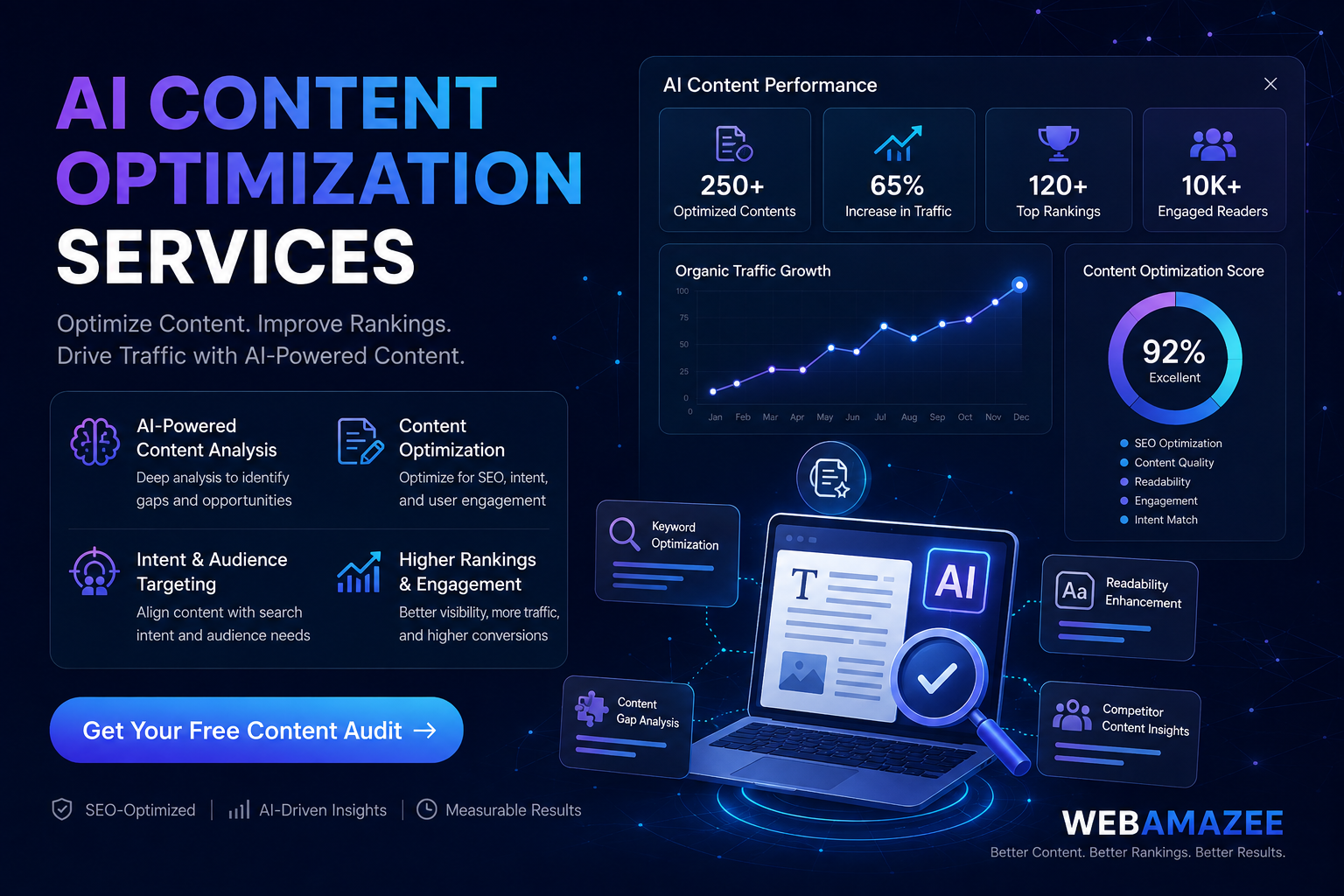
Content that ranks in Google — and gets cited by ChatGPT, Gemini, Perplexity, Claude, and AI Overviews.
Most agencies still optimize content for a search engine that no longer works the way it did in 2021. Google now answers questions directly through AI Overviews. ChatGPT, Perplexity, and Gemini pull answers from the web and cite sources without a single click. If your content isn’t structured for machines to parse, verify, and quote — it doesn’t matter how well it reads to a human. It won’t get chosen.
Webamazee’s AI Content Optimization Services
rebuild your existing content — and the content you haven’t written yet — so it satisfies two audiences at once: the person searching, and the model deciding whether to cite you. We’ve run this process on hundreds of pages across SaaS, eCommerce, local service, and enterprise sites, and we know exactly which structural, semantic, and authority signals move the needle and which ones are folklore.
Get a free AI content audit: we’ll show you which pages are losing visibility in AI search, why, and the exact fix — before you spend a dollar with us.
What Are AI Content Optimization Services?
AI Content Optimization Services are the process of restructuring, rewriting, and technically enhancing web content so it can be accurately parsed, understood, and cited by both traditional search algorithms (Google, Bing) and generative AI systems (ChatGPT, Gemini, Perplexity, Claude, Copilot, Google AI Overviews). This includes semantic structuring, entity clarity, answer-first formatting, schema markup, source credibility signals, and topical depth that AI models can extract and trust.
Traditional SEO content optimization was built around a simpler model: a crawler indexes your page, a ranking algorithm scores it against roughly 200 signals, and a human clicks a blue link. That model still exists, but it’s no longer the only — or even primary — path to visibility for a growing share of queries.
AI-powered search doesn’t rank ten blue links. It generates one answer, synthesized from multiple sources, and decides in real time which of those sources deserves a citation. That decision isn’t made by crawling your whole site and weighing backlinks over weeks. It’s made by a language model retrieving passages, checking whether those passages directly and confidently answer the query, and evaluating whether the surrounding content gives it a reason to trust — or distrust — what it just read.
Traditional SEO vs. AI Content Optimization — the practical difference
Traditional SEO content optimization asks: ‘Does this page satisfy Google’s ranking algorithm for this keyword?’ AI content optimization asks a harder question: ‘If a language model retrieved this exact paragraph with no other context, would it understand what it’s reading, trust the claim, and be able to attribute it correctly?’ That second question forces changes traditional SEO never required — self-contained paragraphs, explicit entity naming instead of pronouns, answer-first structure instead of narrative build-up, and verifiable specificity instead of vague authority claims.
Why do AI-powered search engines evaluate content differently than Google’s classic ranking system? Because they aren’t ranking pages — they’re extracting passages. A model like the one behind AI Overviews or Perplexity retrieves chunks of text (often a few sentences to a paragraph), scores each chunk for relevance and reliability, and stitches an answer together from the chunks that pass. A page can rank #1 in classic search and still be invisible in AI search if every paragraph depends on the paragraph before it to make sense — because the model may only ever see one chunk at a time.
Why AI Content Optimization Matters
Search behavior has fractured across more surfaces than at any point in the last two decades, and each surface has its own evaluation logic. Optimizing for only one of them is how sites lose visibility while their team insists ‘nothing changed on our end.’
- Google Search (classic organic): Still driven by relevance, E-E-A-T, backlink authority, and crawl/index fundamentals — but re-ranking now leans more heavily on passage-level relevance and helpful-content signals than it did before the 2022–2024 Helpful Content updates.
- Google AI Overviews: Generated from a synthesis model that pulls from top-ranking and semantically relevant pages, favoring content that answers the query directly within the first 1–2 sentences of a section and that carries clear source attribution.
- ChatGPT (with browsing/search): Retrieves and summarizes web content, weighting recency, specificity, and the presence of structured data (headings, lists, tables) that make extraction easier and less error-prone.
- Gemini: Tightly linked to Google’s Knowledge Graph and index, so entity clarity and structured data have an outsized effect on whether Gemini can confidently attribute a claim to your brand.
- Perplexity: Built as an answer engine first — it rewards content with explicit citations, data points, and dates, because its own output format mimics a research brief with sources.
- Claude: When browsing, favors content that reads as a primary or well-sourced secondary source — original data, named experts, and clear methodology outperform aggregated or reworded summaries.
- Microsoft Copilot: Runs on Bing’s index and applies similar structured-data and entity-recognition logic to Bing Search, with a heavier weighting toward IndexNow-submitted, freshly updated content.
Underneath all seven of these surfaces sit the same five concepts, and if your content strategy doesn’t explicitly address each one, you’re optimizing by guesswork:
- Search Intent: whether your content matches what the searcher actually wants to accomplish — informational, navigational, transactional, or commercial-investigation — not just the keyword they typed.
- Semantic SEO: structuring content around meaning and relationships between concepts, not exact-match keyword density, so the page reads as coherent expertise rather than a keyword list.
- Entity SEO: making sure your brand, people, products, and locations are unambiguously identifiable as distinct real-world entities that Google’s Knowledge Graph and AI models can connect to other verified data about you.
- Topical Authority: demonstrating comprehensive coverage of a subject area across multiple interlinked pages, not just one well-optimized article, so both algorithms and models treat your site as a credible source on the topic.
- Natural Language Processing (NLP) alignment: writing in a way that parses cleanly into subject-predicate-object relationships, because both Google’s ranking systems and generative models rely on NLP to extract meaning, and ambiguous phrasing gets misread or ignored.
Our Webamazee AI Content Excellence Framework™
We don’t run a generic content checklist. Every engagement follows our Webamazee AI Content Excellence Framework™ — an 11-stage process built from what has actually moved rankings and AI citations across the accounts we manage, not from a blog post about best practices.
1. AI Content Audit
We crawl your existing content and score every page against a 40-point rubric covering answer-first structure, entity clarity, passage independence, schema coverage, freshness, and citation-readiness. You get a page-by-page priority list, not a vague ‘content is thin’ summary.
2. Search Intent Mapping
We map every target query to its true intent using SERP feature analysis — checking whether Google shows a featured snippet, a People Also Ask block, a shopping carousel, or an AI Overview for that query, because each of those signals a different content format the query actually wants.
3. Entity Optimization
We identify every entity your content should be unambiguously associated with — your brand, founders, products, service areas, and industry terms — and make sure those entities are named explicitly (not just implied with ‘we’ or ‘our solution’) and, where relevant, connected to structured data and your Knowledge Panel.
4. Semantic SEO Enhancement
We expand thin, keyword-repetitive copy into semantically rich content that covers the full cluster of related concepts a topic requires, using co-occurring terms and related entities instead of repeating the exact-match keyword.
5. Topical Authority Building
We build or complete the topic cluster around your core service — pillar page plus supporting subtopic pages, interlinked deliberately — so the site as a whole, not just one article, reads as authoritative to both algorithms and AI models.
6. Content Structure Optimization
We rebuild heading hierarchy so H2s ask the actual question a user or AI model would ask, and the first sentence under each heading answers it directly — because both featured snippets and AI Overviews extract the first 1–3 sentences after a heading far more often than buried answers.
7. AI Readability Optimization
We rewrite paragraphs to be self-contained — each one makes sense if a model retrieves it in isolation, with the subject named explicitly rather than replaced by a pronoun, because retrieval systems frequently pull a single paragraph with no surrounding context.
8. EEAT Enhancement
We add verifiable experience signals — named authors with real credentials, first-hand specifics, original data or examples, and citations to primary sources — because generic, unattributed claims are exactly what Google’s Helpful Content systems and AI trust scoring are designed to discount.
9. Internal Linking Optimization
We rebuild internal links around topical relationships rather than random anchor text, using descriptive anchors that tell both users and crawlers what the linked page is about, and closing orphan-page gaps that quietly suppress topical authority.
10. Content Refresh Strategy
We set a content decay schedule based on how fast a topic actually changes — a pricing page might need quarterly updates, a foundational explainer might only need an annual review — and update dates, data points, and examples on that cadence instead of leaving pages to go stale.
We track classic rankings, AI Overview appearances, and — where tools allow — citation frequency in ChatGPT, Perplexity, and Gemini for your target queries, then feed that data back into the next optimization cycle.
What We Optimize
Every engagement touches the same core surface area. Depending on your audit results, we prioritize differently, but nothing on this list gets skipped without a documented reason:
- Search Intent — matching content format to what Google’s SERP already shows the algorithm wants
- Content Structure — logical flow from broad concept to specific detail, without circular or redundant sections
- Heading Hierarchy — H2s and H3s framed as the actual questions users and AI models ask
- Semantic Keywords — related concepts and co-occurring terms instead of exact-match repetition
- Entities — explicit, unambiguous naming of brand, people, products, and locations
- NLP Optimization — sentence structures that parse cleanly into clear subject-predicate-object relationships
- Internal Linking — descriptive, topically relevant links that reinforce your content clusters
- External Authority Signals — links to and from credible, relevant sources that support E-E-A-T
- Topical Authority — comprehensive cluster coverage, not a single isolated article
- Content Freshness — dated updates on a cadence matched to how fast the topic changes
- FAQ Optimization — direct, snippet-ready answers formatted for extraction
- Featured Snippets — answer-first paragraphs and lists structured to win position zero
- Voice Search — conversational, question-based phrasing that matches spoken queries
- Schema Markup — Article, FAQPage, Service, and Organization schema so machines can verify what they’re reading
- EEAT Signals — named authors, credentials, original examples, and transparent sourcing
- Core Web Vitals Alignment — flagging performance issues that suppress otherwise strong content
- Readability — sentence length, paragraph length, and jargon calibrated to the actual audience
- Content Depth — comprehensive coverage that closes the gaps competitors leave open
- Originality — first-hand insight and examples that can’t be found verbatim elsewhere
- AI Citation Potential — passage independence and factual specificity that make a paragraph safe for a model to quote
- Generative Search Visibility — overall structural and authority readiness for AI Overviews, ChatGPT, Gemini, Perplexity, Claude, and Copilot
What We Deliver
You don’t get a PDF of generic recommendations. Every engagement includes concrete, page-specific deliverables your team — or ours — can act on immediately:
- Complete Content Audit: Every existing page scored against our 40-point AI-readiness rubric, prioritized by traffic and revenue impact.
- AI Optimization Report: A page-by-page breakdown of exactly what’s blocking AI citation and classic ranking, with before/after examples.
- Search Intent Analysis: SERP feature mapping for every target query, showing which content format each query actually rewards.
- Entity Map: A documented map of your brand, people, products, and locations, and how clearly each is currently established as a distinct entity.
- Semantic SEO Recommendations: The specific related terms, concepts, and entities missing from each page’s current coverage.
- Content Gap Analysis: The subtopics your competitors rank and get cited for that your site doesn’t cover yet.
- Internal Linking Plan: A link map connecting pillar and cluster content with descriptive, intent-matched anchor text.
- Schema Recommendations: Exact schema types and required properties for each page, ready to hand to a developer.
- Content Refresh Roadmap: A cadence and priority order for updating existing content based on decay risk.
- Performance Tracking: Baseline and ongoing tracking of rankings, AI Overview appearances, and citation activity.
- Monthly Optimization Reports: Plain-language reporting on what changed, why, and what’s next — no vanity metrics.
Key Features
Traditional SEO Content vs. AI Optimized Content
| Factor | Traditional SEO Content | AI Optimized Content |
| Primary goal | Rank in the top 10 blue links | Rank AND get retrieved/cited by AI answer engines |
| Keyword approach | Exact-match density and variations | Semantic coverage of the full topic cluster |
| Paragraph design | Narrative flow, context builds over the page | Self-contained, retrievable in isolation |
| Heading role | Organizational / stylistic | Direct question the first sentence must answer |
| Authority signals | Backlinks and domain metrics | Backlinks plus named E-E-A-T, entity clarity, schema |
| Freshness | Updated when someone remembers to | Scheduled refresh based on topic decay rate |
Generic AI Content vs. Webamazee Optimized Content
| Factor | Generic AI-Generated Content | Webamazee Optimized Content |
| Origin | Drafted by an LLM with a broad prompt | Drafted or restructured with editorial and SEO oversight at every stage |
| Specificity | Generic claims, no verifiable detail | Real data points, named examples, original analysis |
| Editorial review | Often published with light or no editing | Every page passes human editorial and fact-check review |
| Structural design | Default paragraph flow | Answer-first structure engineered for extraction |
| EEAT signals | Anonymous or absent authorship | Named authors, credentials, and sourcing shown |
| Risk profile | Vulnerable to Helpful Content and quality downgrades | Built to satisfy Google’s quality guidelines from the start |
Benefits
Better structure and clearer entities aren’t the end goal — they’re the mechanism. Here’s what clients actually see change:
- More qualified organic traffic: content that matches true search intent brings visitors closer to a buying decision, not just more pageviews.
- Visibility in AI Overviews and answer engines: pages structured for passage-level extraction start appearing as cited sources in Google AI Overviews, Perplexity, and ChatGPT search results.
- Reduced content decay: a scheduled refresh cadence means fewer pages quietly sliding out of rankings six months after publication.
- Stronger topical authority: closing content gaps and interlinking clusters compounds ranking strength across the whole site, not just one page.
- Lower cost per qualified lead: content that actually answers the query converts better, which reduces reliance on paid acquisition to hit pipeline targets.
- Defensible content assets: original data and named expertise are harder for competitors — human or AI-generated — to replicate or outrank.
Why Choose Webamazee
Anyone can promise ‘AI-optimized content.’ What matters is the process behind that promise, so here’s ours, without the vague claims:
- Methodology: Every page goes through the same 11-stage Webamazee AI Content Excellence Framework™ — audit, intent mapping, entity work, semantic enhancement, structure, readability, EEAT, linking, refresh planning, and monitoring. Nothing skips a stage because a deadline is tight.
- Quality standards: we score pages against a documented 40-point rubric before and after optimization, so improvement is measured, not assumed.
- Editorial review process: every optimized or AI-assisted draft is reviewed by a human editor for accuracy, tone, and factual grounding before it’s ever considered final.
- Content validation process: claims and data points are checked against primary sources before publication — we don’t let an AI-generated statistic go live unverified.
- AI optimization workflow: we use AI tools to accelerate research, drafting, and structural analysis, but strategic decisions — what to say, what to cut, how to position a claim — are made by strategists who understand your market, not by a prompt.
- Decision-making process: every structural change is tied back to a specific SERP feature, AI retrieval pattern, or ranking signal we observed — not a generic ‘best practice’ with no evidence behind it.
Why strategy matters more than the AI tools you use
The tools that generate and analyze content are now widely available — every agency has access to the same language models we do. What separates results isn’t tool access; it’s judgment: knowing which query deserves a comparison table versus a step-by-step guide, which claim needs a named source to survive a trust check, and which pages in your existing library are quietly costing you visibility because nobody has touched them since 2022. That judgment comes from running this process on hundreds of live sites and watching what actually happened in rankings and AI citations afterward — not from reading about it.
Industries We Serve
| Industry | What We Focus On |
| SaaS Companies | Technical, feature-dense content that needs to satisfy both developer-level accuracy and AI Overview simplicity. |
| eCommerce Brands | Product and category content that must win featured snippets, shopping-intent queries, and AI shopping assistants. |
| Local Businesses | Location-specific entity clarity and structured data that connect your business to local search and map results. |
| Enterprise Companies | Large content libraries requiring systematic auditing and topical authority across dozens or hundreds of pages. |
| Startups | Building topical authority from near-zero, prioritized around the queries most likely to drive early revenue. |
| Marketing Teams & Agencies | White-label and in-house support for teams that need AI optimization capacity without hiring a specialist internally. |
Common AI Content Optimization Mistakes
Most of the content underperforming in AI search today isn’t bad — it’s undermined by a handful of repeatable mistakes. Here’s what we see constantly, and how we avoid each one:
Publishing AI content without editing
Unedited AI drafts read as generic and often contain confidently stated inaccuracies. We route every draft through human editorial review and fact-checking before publication.
Ignoring EEAT
Content with no named author, no credentials, and no first-hand specifics gets discounted by Google’s quality systems and by AI trust scoring. We build named authorship and verifiable experience into every piece.
Ignoring entities
Vague references (‘our solution,’ ‘this approach’) prevent AI models from connecting content to your brand. We name entities explicitly and consistently across the site.
Weak topical authority
One well-optimized article surrounded by thin, unrelated content doesn’t read as expertise. We build complete topic clusters, not isolated pages.
Keyword stuffing
Repeating exact-match phrases reads as spam to both classic ranking systems and language models. We optimize for semantic coverage instead.
Poor content structure
Answers buried three paragraphs into a section get skipped by both featured snippets and AI extraction. We put the answer in the first sentence, every time.
Thin content
Pages that don’t fully answer the query force users and AI models to look elsewhere. We build to genuine topic depth, not a word-count target.
No internal linking
Orphaned pages signal low importance to crawlers and break the topical relationships models rely on. We interlink every page with descriptive anchors.
No schema markup
Without structured data, machines have to infer what a page is about instead of being told directly. We implement Article, FAQPage, Service, and Organization schema as standard.
No search intent optimization
Content that answers the wrong question — a listicle where the SERP wants a comparison table — will never rank, no matter how well-written it is. We map intent from the actual SERP before writing a word.
Frequently Asked Questions
What is AI Content Optimization?
AI Content Optimization is the process of structuring, writing, and technically enhancing content so it can be accurately parsed, trusted, and cited by AI-powered search systems — including Google AI Overviews, ChatGPT, Gemini, Perplexity, Claude, and Copilot — while still satisfying traditional Google ranking factors.
Can AI-written content rank on Google?
Yes, if it’s genuinely helpful, accurate, and edited by a qualified human before publication. Google has stated it evaluates content on quality and helpfulness regardless of how it was produced, not on whether AI was involved in drafting it. The risk isn’t AI assistance — it’s publishing unedited, generic, low-value output at scale.
Does Google penalize AI content?
Google doesn’t penalize content for being AI-assisted. It penalizes content created primarily to manipulate rankings rather than help users — a practice its spam policies describe as scaled content abuse. Well-researched, edited, genuinely useful content is treated the same whether a human or an AI drafted the first version.
How does AI Search evaluate content?
AI search systems typically retrieve relevant passages from indexed pages, score them for relevance and reliability, and synthesize an answer from the passages that pass. Content that answers a question directly, in a self-contained paragraph, with clear entity attribution, is far more likely to be extracted and cited than content that requires surrounding context to make sense.
How often should content be updated?
It depends on how fast the topic changes. Pricing, statistics, and product-specific pages often need review every 1–3 months. Foundational explainer content can go 6–12 months between refreshes. We set a page-specific cadence during the audit rather than applying one blanket schedule to everything.
What is entity SEO?
Entity SEO is the practice of making sure real-world things — your brand, founders, products, and locations — are unambiguously identifiable and consistently referenced, so search engines and AI models can connect your content to verified data about those entities in knowledge graphs, rather than treating every mention as a fresh, unconnected reference.
How does semantic SEO help AI search?
Semantic SEO structures content around meaning and the relationships between concepts, not exact-match keyword repetition. Because AI models process language through meaning rather than string matching, semantically rich content is easier for them to interpret correctly and more likely to be judged comprehensive enough to cite.
Can optimized content appear in AI Overviews?
Yes. Google has confirmed AI Overviews draw from the same core web ranking systems used in traditional Search, so pages that already rank well and are structured with clear, answer-first passages have a realistic path to appearing as a cited source in an Overview.
What's the difference between GEO and traditional SEO?
Generative Engine Optimization (GEO) focuses specifically on making content retrievable and citable by generative AI systems — passage independence, entity clarity, and source credibility. Traditional SEO focuses on ranking algorithms and click-through behavior. The two overlap heavily but aren’t identical, which is why a page can rank #1 and still be ignored by an AI Overview.
How long does AI content optimization take to show results?
Technical and structural changes (schema, heading restructuring, internal linking) can influence crawling and re-indexing within days to a few weeks. Ranking and AI citation improvements tied to authority and trust signals typically take 60–120 days to fully materialize, depending on how competitive the topic is and how frequently the AI system re-crawls its sources.