Competitor Analysis Services
Get Your SEO Competitor Analysis
If you’re not sure whether this is worth the investment, that’s a fair question — here’s a direct answer to the ones we hear most.
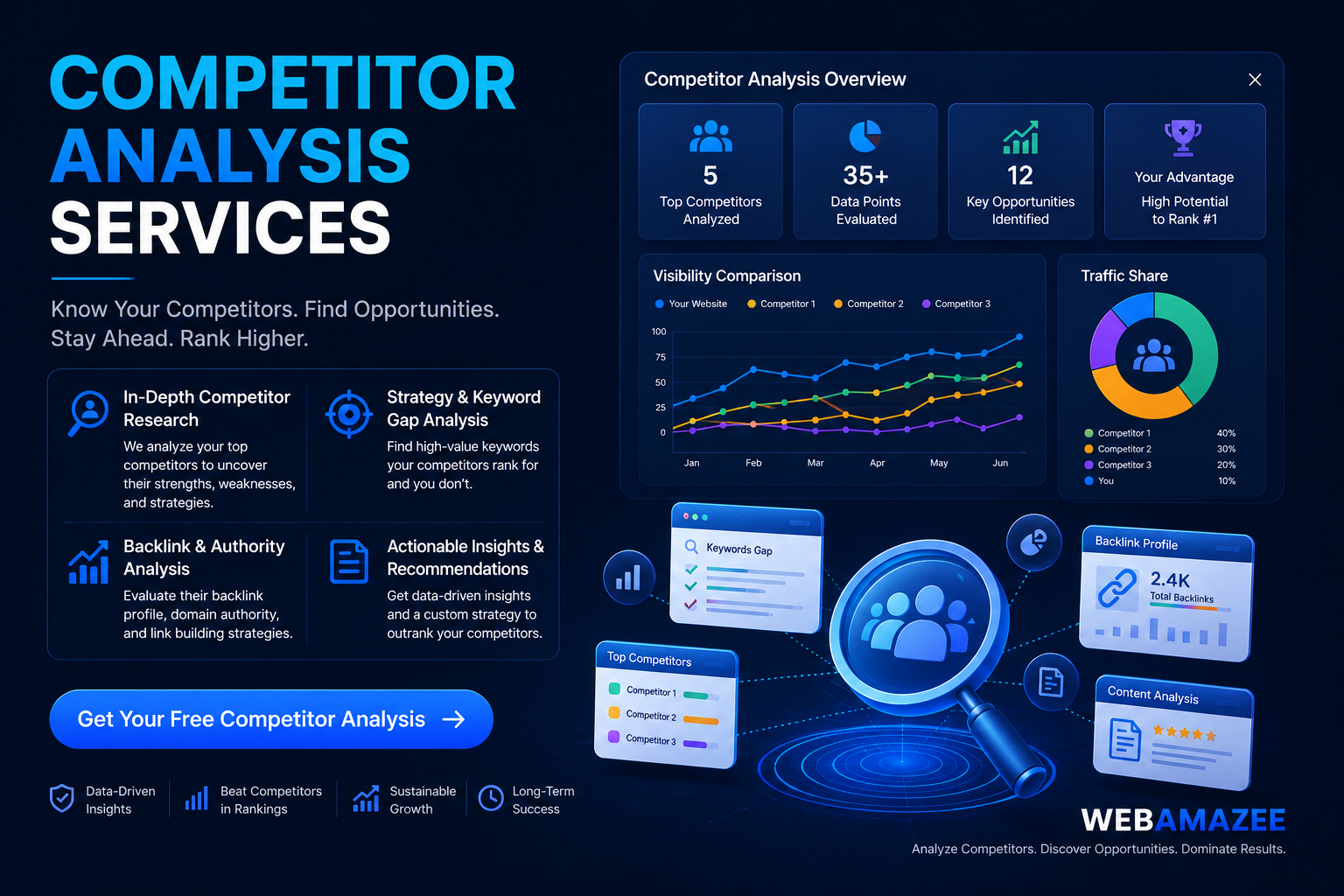
Know Exactly Why Competitors Outrank You — And Exactly How to Overtake Them
Most SEO competitor analysis stops at a keyword export. Ours doesn’t. Webamazee’s SEO Competitor Analysis Services combine keyword gap analysis, backlink intelligence, technical SEO benchmarking, and search-intent mapping into a single prioritized action plan — built by strategists who have run this process on hundreds of live websites, not a template pulled from a tool’s default report.
If you’re losing rankings, traffic, or leads to competitors and don’t know why, this is the service that tells you exactly where the gap is, why it exists, and what to do about it first.
What Are SEO Competitor Analysis Services?
In practice, that definition covers a wide range of research disciplines that most agencies treat as separate services: keyword research, backlink audits, content audits, and technical SEO reviews. We treat them as one connected system, because that’s how Google’s ranking systems actually evaluate a website — holistically, not as isolated signals.
A genuine SEO competitor analysis answers three questions with evidence, not opinion:
- Where is the competitor winning, specifically — which pages, which keywords, which SERP features?
- Why are they winning — content depth, backlink authority, technical performance, or search intent match?
- What is the fastest, highest-leverage way to close that gap for your site specifically?
This is also increasingly relevant to AI search. Large language model-based engines like ChatGPT, Gemini, and Perplexity, along with Google AI Overviews, tend to surface sources that demonstrate clear topical depth and entity relevance around a query. Understanding which competitors are being cited by these systems — and why — is now part of a complete competitor analysis, not an optional add-on.
Why SEO Competitor Analysis Matters
SEO decisions made without competitive context are guesses dressed up as strategy. You can publish content, build links, and fix technical issues indefinitely without moving the needle if you’re not addressing the actual gap between you and the sites currently occupying page one.
Search Visibility
Ranking positions are relative, not absolute. A page can be technically excellent and still rank on page two simply because three competitors have stronger topical authority on that specific query cluster. Competitor analysis shows you the visibility ceiling you’re up against before you invest in content that can’t break through it.
Keyword Opportunities
Every competitor has keywords they rank for that you don’t — and, just as importantly, keywords neither of you rank for yet. The first category is a gap to close; the second is a gap to own before anyone else does. Most businesses only look at the first.
Content Strategy
Competitor content audits reveal what search intent actually looks like for your industry’s queries — not what you assume it looks like. If every top-ranking competitor answers a query with a comparison table and you’re publishing a narrative blog post, intent mismatch is the reason you’re not ranking, regardless of writing quality.
Backlink Growth
Backlink profiles compound over years. Analyzing where competitors earn links — guest posts, digital PR, resource pages, partnerships — gives you a realistic map of acquirable link opportunities in your niche, instead of a generic outreach list that ignores what’s actually worked in your market.
Technical Improvements
Site speed, crawlability, and Core Web Vitals are comparative, not absolute, ranking factors in practice — Google has been clear that content relevance still leads, but technical performance can be a tie-breaker in competitive niches. Benchmarking your technical SEO against competitors, in line with guidance from Google Search Central, shows you where that tie-breaker is working against you.
Market Positioning
Competitor analysis isn’t only about search engines. It surfaces how competitors position their offers, pricing, and messaging in organic content — insight that directly informs your own positioning, not just your rankings.
AI Search Visibility
AI answer engines synthesize responses from sources that show clear, well-structured expertise on a topic. If competitors are being cited in AI Overviews or referenced by ChatGPT and Perplexity for your core topics, that’s a visibility gap traditional rank tracking won’t show you — and one we now analyze as standard.
The pattern across all six areas is the same: competitor analysis converts uncertainty into a prioritized list of actions, ranked by effort and impact, instead of a general sense that “we should be doing more SEO.”
Our Webamazee Competitive Intelligence Framework™
We built the Webamazee Competitive Intelligence Framework™ after noticing the same failure pattern across client accounts: businesses had competitor data, but no system for turning it into sequenced action. The framework fixes that by moving through nine defined stages, each with its own output that feeds directly into the next.
1. Discovery
We start by defining who your real competitors are in search — not brand competitors, but the domains actually ranking for your priority keywords. These are often different lists, and confusing them is one of the most common mistakes we see (more on that below).
2. Competitive Benchmarking
We establish a performance baseline: visibility score, estimated organic traffic, ranking keyword count, domain authority, and content volume for you and each competitor, so every later stage has a fixed point of comparison.
3. Keyword Gap Analysis
We cross-reference ranking keyword sets across all competitors to isolate three categories: keywords you’re missing entirely, keywords you’re underperforming on relative to competitors, and untapped keywords none of you have targeted yet.
4. Content Gap Analysis
We audit the actual content competitors have published against those keyword gaps — mapping topic depth, format, media use, and structure to identify exactly what type of content is required to compete, not just that content is required.
5. Backlink Intelligence
We analyze competitor backlink profiles for link velocity, referring domain quality, anchor text patterns, and acquisition sources, then filter that list down to links that are realistically attainable for your site and industry.
6. Technical SEO Comparison
We benchmark Core Web Vitals, crawl efficiency, indexation, mobile usability, and site architecture against competitors to identify where technical friction is actively suppressing your rankings versus where it’s a non-issue.
7. SERP Opportunity Mapping
We map SERP features — featured snippets, People Also Ask, image packs, video carousels, local packs, and AI Overviews — for your priority keywords to identify which features are winnable and what content format each one requires.
8. Action Plan
Every finding from stages 1–7 is consolidated into a single prioritized roadmap, sequenced by projected impact and implementation effort, so your team or ours knows exactly what to execute first, second, and third.
9. Performance Tracking
Competitor positions shift. We set up ongoing tracking against the same competitor set so the strategy adapts as the competitive landscape changes, rather than going stale the month after delivery.
What We Analyze
A surface-level competitor report checks three or four metrics. Our analysis covers the full set of signals that determine organic and AI search visibility.
Keyword Gaps
We segment keyword gaps by search intent and business value, not just search volume — a high-volume informational keyword and a low-volume transactional keyword are not equal opportunities, even if a spreadsheet makes them look similar.
Competitor Content
We assess content depth, format, freshness, and structure page-by-page for top-ranking competitor URLs, identifying the specific elements — comparison tables, FAQs, original data, schema — that correlate with their rankings.
Backlink Profiles
We evaluate referring domain authority, topical relevance of linking sites, anchor text distribution, and link acquisition velocity to separate genuinely influential backlinks from low-value directory links that inflate a domain authority score without moving rankings.
Entity SEO and Topical Authority
Modern search systems rank sites partly on how comprehensively they cover a topic’s related entities, not just individual keywords. We map the entity and subtopic coverage of top competitors against yours to identify topical authority gaps that keyword tools alone won’t surface.
AI Search Visibility
We check whether competitors are being cited or referenced in AI Overviews, ChatGPT, Gemini, and Perplexity responses for your core topics, and analyze what structural and content factors — clear definitions, structured data, authorship signals — appear to support that visibility.
Beyond these five, every analysis also covers the following areas in detail:
| Area | What We Look At |
| Technical SEO | Crawlability, indexation, site architecture, redirect chains, canonicalization |
| Core Web Vitals | LCP, INP, and CLS benchmarked against competitor pages, per Google Core Web Vitals standards |
| Internal Linking | Link equity flow, orphan pages, anchor text strategy across competitor site structures |
| Search Intent | Informational, commercial, transactional, and navigational intent alignment by keyword cluster |
| SERP Features | Featured snippets, PAA boxes, image/video packs, local packs, AI Overviews eligibility |
| Brand Mentions | Unlinked brand citations and digital PR presence relative to competitors |
| Structured Data | Schema.org markup types in use and how they support rich result eligibility |
| Content Freshness | Update frequency and content decay patterns on competitor ranking pages |
| Indexing | Index coverage, crawl budget efficiency, and indexation issues via Google Search Console data |
| User Experience | Navigation, page layout, and conversion-path friction on competitor sites |
| Conversion Opportunities | Where competitors convert organic traffic and where your funnel underperforms by comparison |
| Local SEO Opportunities | Google Business Profile strength, local citations, and map pack visibility where relevant |
What We Deliver
| Deliverable | What’s Inside |
| Comprehensive Competitor Report | Full benchmarking across visibility, content, backlinks, and technical SEO for your top 3–5 competitors |
| Keyword Opportunity Report | Prioritized keyword gap list segmented by intent, difficulty, and business value |
| Backlink Gap Report | Attainable link targets sourced directly from competitor backlink profiles |
| Content Gap Report | Specific content briefs mapped to unranked topics and underperforming pages |
| Technical SEO Audit | Site health comparison covering Core Web Vitals, crawlability, and indexation |
| Priority Roadmap | Every recommendation sequenced by impact-to-effort ratio, not delivered as a flat list |
| Action Plan | Assigned next steps your internal team or our team can execute immediately |
| Monthly Insights | Ongoing tracking of competitor movement so the strategy stays current |
Key Features
| Feature | Typical Tool-Only Report | Webamazee Analysis |
| Keyword gap data | Raw export, unsorted | Segmented by intent and business value |
| Backlink data | Full list, no filtering | Filtered to realistically attainable targets |
| Content review | Word count comparison | Structure, depth, and intent-match review |
| Technical SEO | Automated score only | Manual review against Core Web Vitals data |
| AI search visibility | Not included | Included as standard |
| Output format | Data dump | Prioritized, sequenced action plan |
| Ongoing tracking | One-time snapshot | Monthly competitor movement tracking |
Benefits
- Stop investing in content and links that don’t move rankings, because every recommendation is tied to a specific competitive gap
- Reduce time-to-decision for your marketing team with a prioritized roadmap instead of raw data
- Identify quick-win keyword opportunities competitors have overlooked entirely
- Protect existing rankings by catching competitor moves before they erode your visibility
- Improve technical performance where it’s actually costing you rankings, not everywhere at once
- Build a backlink strategy based on what has demonstrably worked in your niche
- Gain visibility into how your brand is — or isn’t — appearing in AI-generated search answers
- Align your SEO investment with measurable business outcomes: traffic, leads, and revenue
Why Choose Webamazee
We won’t tell you we use “proprietary AI technology” to analyze competitors, because the tools that pull competitor data — Ahrefs, Semrush, and similar platforms — are the same ones most agencies use. The difference isn’t the tool. It’s what happens after the data is pulled.
Our Methodology
Every competitor analysis follows the nine-stage Webamazee Competitive Intelligence Framework™ described above. This isn’t a marketing name for “we’ll look into it” — it’s a fixed sequence that ensures nothing gets skipped and every finding is traced back to a specific business decision.
Our Quality Standard
A recommendation only makes it into your final report if we can answer one question about it: what specifically will happen if you act on this, and how will we measure it? Findings that don’t meet that bar get cut, even if they’re technically true. Vague advice like “publish more content” isn’t an insight; it’s a placeholder for one.
How We Make Decisions
When a keyword gap and a backlink gap compete for the same budget, we don’t default to whichever is easier to sell. We model both against your current site authority, content velocity, and sales cycle, and recommend whichever produces the faster measurable return for your specific business stage.
Why Strategy Matters More Than Tools
Two agencies can run the same competitor through the same software and produce entirely different reports, because the software only surfaces data — it doesn’t interpret it. Interpretation requires having done this enough times to know which patterns are noise and which ones are the actual reason a competitor outranks you. That judgment is what you’re paying for, not the data export.
This analysis also directly informs the services it connects to: findings feed into Keyword Research, On-Page SEO, Technical SEO, Content Marketing, and — where relevant — Local SEO and AI SEO Services, so the insight doesn’t sit in a PDF. If you’d like to see how this plays out in practice, our Case Studies document real before-and-after outcomes, and our About Us page covers how our team approaches this work.
Industries We Serve
- eCommerce & Online Retail
- SaaS & Technology Companies
- Startups & Growth-Stage Companies
- Local & Service-Based Businesses
- Enterprise & Multi-Location Brands
- Marketing & Creative Agencies (white-label)
- Healthcare & Professional Services
- Real Estate & Hospitality
Every analysis is scoped to how competition actually works in that industry — a local service business competes on map pack visibility and review signals, while a SaaS company competes on topical authority and comparison-page rankings. The framework stays the same; the priority weighting inside it changes.
Common Competitor Analysis Mistakes
Most competitor analysis fails not because the data is wrong, but because of how it’s gathered and used. These are the mistakes we see most often — and specifically avoid.
| Mistake | Why It Fails | How Webamazee Avoids It |
| Comparing brand competitors instead of SERP competitors | The businesses you compete with offline often aren’t who you compete with in search results | We identify competitors from actual ranking data for your priority keywords, not your competitor list |
| Treating every keyword gap as equal | A gap in a 50-search-volume keyword and a 5,000-search-volume keyword aren’t the same opportunity | We segment every gap by intent and business value before prioritizing |
| Copying backlink lists without filtering | Many competitor backlinks are low-value, spammy, or simply unattainable for your site’s current authority | We filter to links that are realistically earnable given your domain’s current profile |
| Ignoring search intent mismatch | Ranking pages often win because of format, not just topic — a listicle can’t outrank a comparison tool if that’s what the query demands | We audit format and structure alongside topic for every gap we flag |
| Treating the analysis as a one-time project | Competitor rankings shift monthly; a static report goes stale fast | Performance tracking is built into the framework as an ongoing stage, not an afterthought |
| Ignoring AI search visibility | Traditional rank tracking misses whether competitors are being cited in AI Overviews or LLM answers | AI search visibility is analyzed as standard in every engagement |
Frequently Asked Questions
How does competitor analysis improve SEO?
Competitor analysis improves SEO by identifying the specific keyword, content, backlink, and technical gaps between your site and higher-ranking competitors, so your team can prioritize the changes most likely to move rankings instead of making improvements without competitive context.
What is keyword gap analysis?
Keyword gap analysis is the process of comparing your ranking keywords against a competitor’s to find terms they rank for that you don’t, terms you underperform on relative to them, and untapped terms neither of you currently target.
How do backlinks influence rankings?
Backlinks act as a trust and authority signal to search engines — pages with links from relevant, authoritative sites tend to rank more easily for competitive terms. Quality and topical relevance of the linking site matter more than raw link count.
How do AI search engines evaluate authority?
AI search engines like ChatGPT, Gemini, and Perplexity, along with Google AI Overviews, tend to favor sources that demonstrate clear, structured expertise on a topic — including comprehensive entity coverage, credible authorship signals, and content that directly answers the underlying question rather than circling it.
What is topical authority?
Topical authority is the degree to which a website comprehensively covers a subject area and its related entities and subtopics, rather than ranking for isolated keywords in isolation. Sites with strong topical authority tend to rank more easily for new content within that subject.
What is entity SEO?
Entity SEO is the practice of optimizing content around real-world concepts, people, places, and things — entities — that search engines recognize and connect, rather than optimizing purely around keyword strings. It’s closely tied to structured data, which you can implement using the vocabulary at Schema.org.
How often should competitor analysis be performed?
A full competitor analysis is typically worth repeating every quarter, with lighter monitoring monthly, since competitor content, backlinks, and rankings shift continuously. Businesses in fast-moving or highly competitive niches often benefit from monthly full reviews.
How many competitors should be analyzed?
Most engagements analyze 3–5 direct SERP competitors in depth. Analyzing more than that tends to dilute focus without adding proportional insight, though we’ll expand the set for businesses competing across multiple distinct keyword clusters.
Is SEO competitor analysis different from a general SEO audit?
Yes. An SEO audit evaluates your own site in isolation. Competitor analysis evaluates your site relative to specific competitors currently outranking you, which is what actually determines whether a fix will change your position in search results.
What happens after the competitor analysis is delivered?
You receive a prioritized action plan your internal team can execute directly, or you can have Webamazee implement it through our connected services — Technical SEO, On-Page SEO, Content Marketing, or AI SEO Services — with monthly tracking to measure movement against the competitors analyzed.